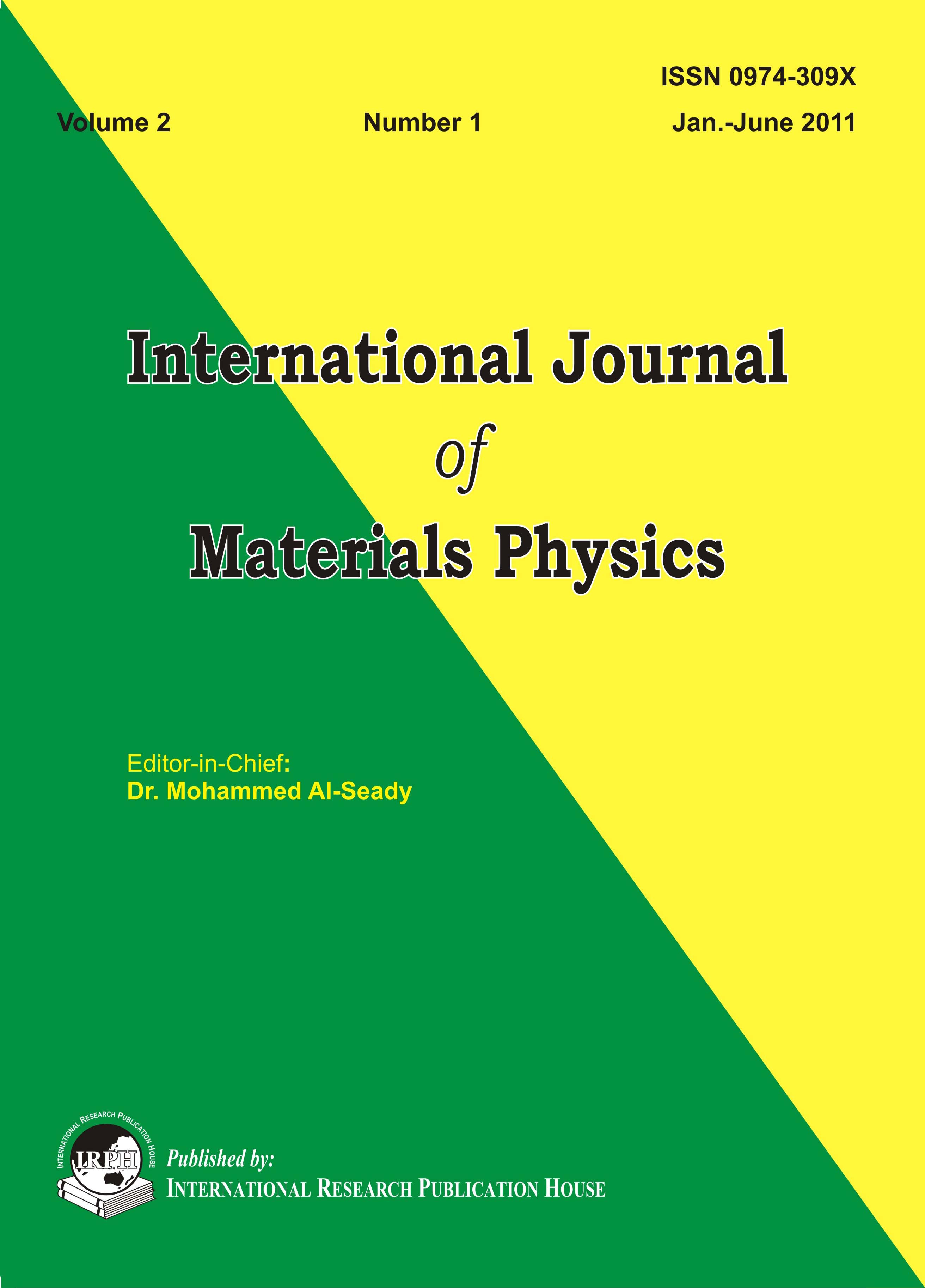
International Journal of Materials Physics (IJMP)
ISSN: 0974-309X
Editor in Chief:
Dr. Mohammed Al-Seady
Head of Department of Physics,
Gizan Teacher’s of College,
Gizan, KSA
The International Journal of Materials Physics (IJMP) is an international scholarly journal dedicated to publishing original research articles that advance knowledge and understanding in materials science, materials physics, and materials engineering. The journal provides a platform for researchers, scientists, academicians, and industry professionals to disseminate innovative findings, theoretical developments, experimental investigations, and technological advancements related to the physical properties, processing, characterization, and performance of materials. It covers a broad spectrum of topics, including materials physics, physical metallurgy, process metallurgy, mining and ore dressing, production metallurgy, foundry technology, metalworking, materials testing and characterization, powder metallurgy, composite materials, welding and joining, oxidation, and corrosion. The journal welcomes high-quality contributions that offer significant scientific or technological insights and address challenges relevant to the international materials research community.
Aim and Scope:
The aim of the International Journal of Materials Physics is to promote the advancement and dissemination of scientific knowledge in materials physics, materials science, and engineering by providing an international forum for original and impactful research. The journal seeks to encourage interdisciplinary collaboration, foster innovation in materials processing and characterization, and enhance understanding of the relationships between material structure, physical properties, processing methods, and performance. It aims to support the development of advanced materials, improved metallurgical processes, and sustainable technologies that contribute to scientific progress and industrial applications worldwide.
The journal's scope includes, but is not limited to, the following areas:
Materials Physics: Physical properties of materials, solid-state physics, electronic and magnetic materials, thermal properties, optical properties, and phase transformations.
Physical Metallurgy: Microstructure evolution, crystallography, phase equilibria, mechanical behavior, heat treatment, deformation, and failure mechanisms in metals and alloys.
Process Metallurgy: Metallurgical processes, extraction and refining, process optimization, and innovations in metal production.
Mining and Ore Dressing: Mineral processing, ore beneficiation, separation techniques, and the characterization of mineral resources.
Production Metallurgy: Ferrous and non-ferrous metal production, extractive metallurgy, refining technologies, and advanced metal processing.
Foundry and Metalworking: Casting processes, solidification, forging, rolling, extrusion, machining, forming, and related manufacturing technologies.
Materials Testing and Characterization: Mechanical, thermal, electrical, magnetic, and physical testing methods; microstructural analysis; and advanced materials characterization techniques.
Powder Metallurgy: Powder synthesis, processing, compaction, sintering, additive manufacturing, and the development of powder-based materials.
Composite Materials: Design, fabrication, characterization, properties, and applications of metal-matrix, ceramic-matrix, polymer-matrix, and other advanced composites.
Welding and Joining: Welding processes, brazing, soldering, diffusion bonding, joining technologies, weld metallurgy, and joint performance.
Oxidation and Corrosion: Oxidation mechanisms, corrosion science, degradation of materials, protective coatings, corrosion prevention, and surface engineering.
Advanced and Functional Materials: Nanomaterials, smart materials, biomaterials, energy materials, multifunctional materials, and emerging material systems.
Materials Processing and Performance: Relationships among processing conditions, microstructure, physical and mechanical properties, durability, and service performance.
Computational and Modeling Approaches: Computational materials science, numerical simulation, materials modeling, and data-driven approaches to materials design and optimization.
Sustainable Materials and Technologies: Resource-efficient processing, recycling and recovery of materials, waste reduction, and environmentally responsible metallurgical practices.
The journal welcomes contributions that present original findings, methodological advances, or meaningful improvements in the understanding and application of materials. Submissions should demonstrate scientific rigor, clear relevance to the journal's subject areas, and significance beyond a narrowly localized context. All articles should be of interest to an international readership and contribute to the advancement of research and practice in materials physics, materials science, and engineering.
IJMP, ISSN0974-309X fulfils the UGC criteria for ethical publication - as per new UGC 9678711_PUBLIC-NOTICE-CARESubmission: irpeditor@gmail.com or submission@irphjournals.com (submit your paper as email attachment).
Types of Contributions
Research Articles: Research Articles should present original and substantive mathematical findings based on theoretical, analytical, computational, numerical or applied investigations. Manuscripts should explain the methods, assumptions, proofs, derivations, computational procedures and results sufficiently to permit appropriate scholarly evaluation.Short Communications: Short Communications are intended for concise reports of significant and well-defined mathematical results. They may present focused theoretical findings, new propositions or methods, concise proofs, novel computational approaches, or other developments of clear relevance to the journal's scope.
Review Articles: The journal welcomes Review Articles that provide systematic, critical and well-structured examinations of significant developments in areas within the journal's scope. Reviews should synthesize relevant mathematical literature, assess established results and current approaches, and identify meaningful directions for further investigation. Review Articles are subject to the journal's peer-review process.
Publication Frequency : two issues per year.
Article Preparation Template [Download - File]
Authors' InformationEditorial Board Members
Peer Review Policy
Publication Ethics and Malpractice Statement
Volume 1 No.1 (2010)
Volume 2 No.1 No.2 (2011)
Volume 3 No.1 No.2 (2012)
Volume 4 No.1 (2013)
Volume 5 No.1 (2014)
Volume 6 No.1 (2015)
Volume 7 No.1 (2016)
Publication Ethics and Research Integrity
Copyright and Licensing
IRPH Vision Map | Journals | Books | Indexing Information | Editorial Diversity | Contact Us | Archiving Information
Copyright © 2026 International Research Publication House. All Rights Reserved.